Bug found in Georgia a threat to soybeans?

Nov 10, 2009 11:25 AM, By Sharon Dowdy, University of Georgia

"It's kind of a double-edged sword. It eats kudzu, which is good, but it also stinks and gets on homes. And the ominous threat is that it eats soybeans and other legume crops."

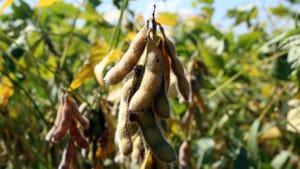
Researchers from the University of Georgia and Dow AgroSciences have identified a kudzu-eating pest in northeast Georgia that has never been found in the Western Hemisphere. Unfortunately, the bug also eats legume crops, especially soybeans.

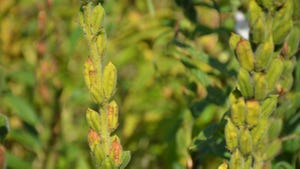
BEAN PLATASPIDS (Megacopta cribraria), an insect native to India and China, has been found in northeast Georgia counties. The bug is pea-sized and brownish in color with a wide posterior. It eats kudzu, but also feeds on legume crops like soybeans. (Photo: Dan Suiter)

The bug has tentatively been identified as the bean plataspid (Megacopta cribraria), a native to India and China. It is pea-sized and brownish in color with a wide posterior, said Dan Suiter, an entomologist with the UGA College of Agricultural and Environmental Sciences.

“It kind of waddles when it walks on a surface, but it flies really well,” he said.

It’s also commonly called lablab bug and globular stink bug. Like its distant cousin the stink bug, when threatened, it releases a chemical that stinks.

Suiter and CAES diagnostician Lisa Ames first saw the pest when samples were sent to them in mid-October from UGA Cooperative Extension agents and pest control professionals in Barrow, Gwinnett and Jackson counties. Samples have since arrived from Clarke, Hall, Greene, Oconee and Walton counties.

Homeowners first reported the pest after finding large groups of the bugs lighting on their homes.

“At one home in Hoshton, Ga., we found the bugs all over the side of a lady’s house,” Suiter said. “There is a kudzu patch behind her home that provides food, and they were attracted to the light color of the siding. At this time of year, the insects are most active in the afternoon when it gets warm.”

In addition to homes, the bug is attracted to light-colored vehicles.

The week the bug samples arrived at Suiter’s lab, Joe Eger was visiting. The Dow AgroSciences field biologist has 35 years of experience studying the bean plataspid insect and has named new genera and species and identified the insect for museums across the world.

Eger’s identification was confirmed by David Rider at North Dakota State University and Tom Henry at the Smithsonian Institution.

Suiter believes the bug arrived here by accident.

“We do have the world’s busiest airport here, but we’ll never know how the bug first got here,” he said. “When it found kudzu here, it found a food source, and it doesn’t have any natural enemies here that we are aware of.”

Suiter says the pest’s populations are, for now, contained to northeast Georgia. It’s an “invasive species feeding on an invasive species.”

Introduced to the U.S. in 1876 from Japan, kudzu was planted in the 1930s to control soil erosion. It now tops the nation’s invasive species list.

“We have no idea what the long-term impact on kudzu will be, but we also have to consider the fact that it feeds on crops, too,” he said. “It’s kind of a double-edged sword. It eats kudzu, which is good, but it also stinks and gets on homes. And the ominous threat is that it eats soybeans and other legume crops.”

“We will be working with the University of Georgia and USDA to find the best way of dealing with this insect,” said Georgia Commissioner of Agriculture Tommy Irvin. “At this time, there is not enough information to determine its current range and what its potential as a pest may be.”

Representatives of each agency have met to form an action plan. Information has been sent to Extension agents and pest control companies across the state.

County agents are asked to look for the bug, scout kudzu patches and report any findings to Suiter. Homeowners who find the pest should call their local Extension office at 1-800-ASK-UGA1.

“We’re still trying to get a handle on what its distribution is in the state,” Suiter said.

How to control the pest in Georgia is a mystery that scientists will have to solve, Eger said. In India and China, manually removing them is the most common way.

“Kudzu is its preferred host. So, it might be helpful by controlling kudzu,” Eger said. “It is a significant pest of soybeans and other types of beans in its native countries. My guess is that it has the potential to be an important pest of all types of beans.”

Get Copyright ClearanceWant to use this article? Click here for options!
© 2010 Penton Media, Inc.


Latest Jobs

resources

events icon events

product info icon tradeshows

tradeshow icon digests

research icon photos

Continuing Education

Accredited in Florida, Georgia, New Mexico, Oklahoma, Texas, South Carolina and Tennessee:


(New Course)
Weed Resistance Management in Cotton

This course covers a wide range of options to effectively control weeds in cotton and reduce the risk of weed resistance management. It is accredited for hours/units for licensed/accredited applicators in 7 U.S. Cotton Belt states (Florida, Georgia, New Mexico, Oklahoma, Texas, South Carolina an d Tennessee. CCA credit is pending).

(New Course)
New Mode of Action Chemistry for Vegetable Production

Integration of a new mode of action compound like Coragen into IPM and IRM programs to control Lepidoptera in leafy greens, fruiting vegetables, peppers and brassica or cole crops is always welcome. This online CE accredited course details how best to use this new mode of action insecticide in intensive vegetable production. It is accredited by the Certified Crop Adviser (CCA) program and by state agencies for licensed applicators in Texas, Georgia, Florida, New Jersey and Pennsylvania.

(New Course)
Utilizing Calcium as Nutrient That Protects Against Disease Organisms

This online accredited course focuses on Calcium, an important plant nutrient in fertilizer management for maximum, healthy plant development as well as disease and pest prevention. It is accredited by the Certified Crop Adviser (CCA) program and for licensed applicators in licensed Georgia, Florida, Pennsylvania and New Jersey. Credit applications are pending in South Carolina, Tennessee, Virginia, West Virginia and Washington.

This course is accredited in Texas, Oklahoma, New Mexico, Virginia, West Virginia and Wyoming as well as for CCA credits:

(New Course)
Spray Drift Management

Keeping crop protection chemicals on the crop for which they are intended has been a cornerstone of farming not only to protect neighboring crops, but to not waste money allowing products to drift off the intended target. This accredited online continuing education course covers the critical elements of spray drift management.

New Course
The ABCs of MRLs

American agriculture exports 20 to 30 percent of its production annually. For specific commodities, the percentage is much higher. When recommending and applying pest management products for crops, license Pest Control Advisers (PCAs)  and applicators and farmers must be aware of which products applied are in compliance with Maximum Residue Limits (MRLs) established by foreign customers. This CE course details the MRL issue and why compliance is critical to marketing into world trade.

Back to Top

Browse Print Issues

Additional Resources

subscribe to Farm Press Daily Delta Farm Press Southwest Farm Press Western Farm Press