Late planting complicates soybean production

Jun 15, 2009 10:01 AM, By Katie Pratt
University of Kentucky

As producers go to plant their crops, many are noticing the delayed planting has resulted in taller, more developed weeds in fields. To combat this problem, producers need to have a good weed management program in place.

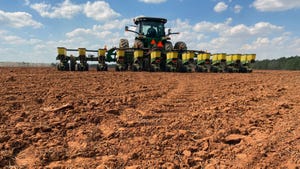
Soybean growers are full-speed ahead with planting, however, the wet spring has put many of them behind schedule.

According to the U.S. Department of Agriculture Weekly Weather Crop Bulletin, 48 percent of Kentucky soybeans were planted as of June 7. This is well behind the five-year average of 71 percent.

Soybeans planted after June 15 are considered late and could cause yield loss. Producers currently planting need a final stand count of 100,000 plants per acre. This number should increase to 140,000 plants per acre for soybeans planted after June 15 and 160,000 plants per acre for double-crop soybeans to help offset yield losses, said Chad Lee, grain crops Extension specialist with the University of Kentucky College of Agriculture.

Even with late-planting looming, it is always better to wait for a couple days of good planting weather than try to mud-in soybeans under wet conditions, he added.

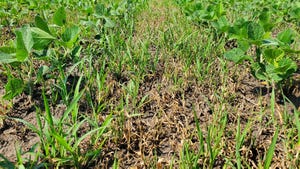
As producers go to plant their crops, many are noticing the delayed planting has resulted in taller, more developed weeds in fields. To combat this problem, producers need to have a good weed management program in place, said J.D. Green, UK Extension weed scientist.

"A good burndown program is needed to kill existing weeds at planting time and allow soybeans to germinate and get off to a good start," he said.

Soybean growers may want to consider using higher rates of glysophate and add 2,4-D to combat weeds at planting time. However, producers should apply 2,4-D with caution where sensitive crops, such as tobacco, grapes or ornamentals, are growing nearby.

Depending on past history and each producer's situation, producers may find it useful to add a soil residual herbicide at planting for early-season weed control. The soil residual herbicide kills weeds as they germinate.

During the growing season, producers need to remove weeds that appear after crop emergence in a timely manner because too many weeds competing with soybeans could result in yield losses.

The good news for growers still planting is late-planted soybeans have a lower disease risk than early-planted soybeans in nearly all diseases with the exception of soybean rust.

"Late planting in soybeans really doesn't affect the disease situation much. In fact, it probably actually helps it," said Don Hershman, UK Extension plant pathologist. "Usually the only disease where there could be an increased risk is with soybean rust."

He added even though there's an increased risk, it doesn't mean soybean rust will affect crops this year. Typically, the state has hot, dry weather after the plants have flowered and before pod set, which normally occurs during July and August. However, if those months are wetter than normal, the soybean rust risk could increase in late-planted and double-cropped soybeans.

Another major factor in soybean rust development is the rate of disease development in the South. Growers can keep track of the soybean rust situation throughout the season by visiting the USDA's soybean rust Web site at http://sbr.ipmpipe.org/cgi-bin/sbr/public.cgi or the University of Kentucky's soybean rust Web site at http://www.ca.uky.edu/agcollege/plantpathology/extension/soybean_rust.html.

Get Copyright ClearanceWant to use this article? Click here for options!
© 2010 Penton Media, Inc.


Latest Jobs

resources

events icon events

product info icon tradeshows

tradeshow icon digests

research icon photos

Continuing Education

Accredited in Florida, Georgia, New Mexico, Oklahoma, Texas, South Carolina and Tennessee:


(New Course)
Weed Resistance Management in Cotton

This course covers a wide range of options to effectively control weeds in cotton and reduce the risk of weed resistance management. It is accredited for hours/units for licensed/accredited applicators in 7 U.S. Cotton Belt states (Florida, Georgia, New Mexico, Oklahoma, Texas, South Carolina an d Tennessee. CCA credit is pending).

(New Course)
New Mode of Action Chemistry for Vegetable Production

Integration of a new mode of action compound like Coragen into IPM and IRM programs to control Lepidoptera in leafy greens, fruiting vegetables, peppers and brassica or cole crops is always welcome. This online CE accredited course details how best to use this new mode of action insecticide in intensive vegetable production. It is accredited by the Certified Crop Adviser (CCA) program and by state agencies for licensed applicators in Texas, Georgia, Florida, New Jersey and Pennsylvania.

(New Course)
Utilizing Calcium as Nutrient That Protects Against Disease Organisms

This online accredited course focuses on Calcium, an important plant nutrient in fertilizer management for maximum, healthy plant development as well as disease and pest prevention. It is accredited by the Certified Crop Adviser (CCA) program and for licensed applicators in licensed Georgia, Florida, Pennsylvania and New Jersey. Credit applications are pending in South Carolina, Tennessee, Virginia, West Virginia and Washington.

This course is accredited in Texas, Oklahoma, New Mexico, Virginia, West Virginia and Wyoming as well as for CCA credits:

(New Course)
Spray Drift Management

Keeping crop protection chemicals on the crop for which they are intended has been a cornerstone of farming not only to protect neighboring crops, but to not waste money allowing products to drift off the intended target. This accredited online continuing education course covers the critical elements of spray drift management.

New Course
The ABCs of MRLs

American agriculture exports 20 to 30 percent of its production annually. For specific commodities, the percentage is much higher. When recommending and applying pest management products for crops, license Pest Control Advisers (PCAs)  and applicators and farmers must be aware of which products applied are in compliance with Maximum Residue Limits (MRLs) established by foreign customers. This CE course details the MRL issue and why compliance is critical to marketing into world trade.

Back to Top

Browse Print Issues

Additional Resources

subscribe to Farm Press Daily Delta Farm Press Southwest Farm Press Western Farm Press