Soybean rust confirmed in Georgia

Asian Soybean Rust has been confirmed in Georgia. Officials confirmed the finding on volunteer soybeans in Seminole County, in southwest Georgia, on April 27, 2005.

The confirmation of Asian Soybean Rust by the University of Georgia’s Plant Disease Clinic in Tifton, Ga., marks the first report of the disease outside of Florida in 2005 and the first report of the disease on a host other than kudzu for the nation this season.

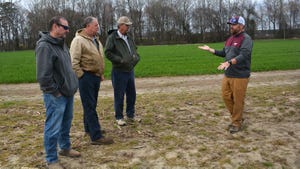
University of Georgia Seminole County Extension Coordinator Rome Ethridge spotted and sent plants with soybean rust symptoms on Monday.

“For growers, this means the likelihood of having problems with soybean rust has increased significantly,” says Phillip Jost, University of Georgia Extension agronomist.

Extension experts earlier looked for soybean rust symptoms on kudzu and crimson clover. On a general search for the disease, Ethridge found soybean rust on kudzu the day before he found it on the volunteer soybeans.

Ethridge found symptoms of the disease on volunteer soybeans “that were getting up toward first bloom,” reports University of Georgia Extension Plant Pathologist Bob Kemerait.

When Ethridge asked a farmer in Seminole County, Ga., where he might find volunteer soybeans growing, the farmer’s answer not only pointed the Extension coordinator to the spot but also added the ominous description: “They kind of look rusty looking.”

“Rusty looking’ is exactly what soybean rust looks like,” Ethridge remembers saying. The farmer had noticed the rust the day before he talked with his county agent.

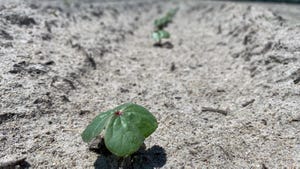
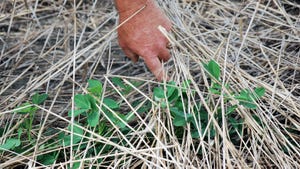
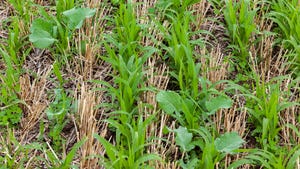
Ethridge found the “rust” on the lower leaves of soybeans sprouting in the field from the 2004 crop. Experts confirmed Asian Soybean Rust in that same field last fall.

“I was surprised to see the soybeans had tiny blooms,” Ethridge says. He points out that rye grass likely shielded the volunteer soybeans from the cold.

“We probably caught soybean rust just as it’s starting,” Ethridge says. “If we’re finding it on soybeans in Georgia, it’s probably just started.”

“It was a very early infection, but Rome was able to identify it and call us,” Kemerait says. Jason Brock, a University of Georgia plant disease diagnostician, confirmed the disease on the plants.

“Now that we know soybean rust is in the state, growers will probably need to spray by R1,” Kemerait says.

In surveys thus far in Georgia, soybean rust has only been found in Seminole County. It has not yet been found in nearby Decatur or Grady counties, nor has the disease been found in more eastern and northern growing areas of Georgia’s soybean production region, Kemerait says.

As for the mood of the farmers in Seminole County, now that soybean rust has been confirmed, Ethridge says, “Farmers are worried about early-season legumes such as snap beans.”

Scouting a field of snap beans across the dirt road from where he found soybean rust on soybeans, Ethridge did not find signs of soybean rust.

“Farmers need to stay tuned and not jump the gun on snap beans and other crops,” Ethridge says.

The county agent recommends “scouting diligently and listening for Extension recommendations.”

Faculty and staff of the University of Georgia’s College of Agricultural and Environmental Sciences are working closely with the Georgia Department of Agriculture and the USDA-APHIS to scout for Asian Soybean Rust across Georgia.

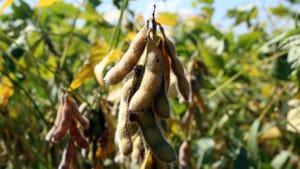
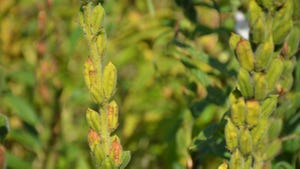
Soybean rust is a foliar disease whose symptoms first appear as small chlorotic and irregularly shaped spots that turn tan to brown or reddish as the disease progresses.

It was first confirmed in the United States last fall in Louisiana, and was later found in eight other states.

Spores on the underside of the leaf can be abundant. The pathogen is well adapted for long-distance dispersal. The spores are readily carried by the wind.

Fungicides have been proven effective in managing the disease.

e-mail: cyancy@primediabusiness.com

Discuss this article 0

Post new comment
Sign In or register to use your Southeast Farm Press ID
(optional)
Connect With Us
Continuing Education Courses
New Course
The course details six of the primary diseases affecting citrus: Huanglongbing (Citrus...
Potassium nitrate has a positive effect in controlling plant pests and diseases when applied...
This online CE course details sound mechanical irrigation design and management practices to...