Georgia soybean growers again brace for Asian rust

Jan 4, 2006 9:05 AM, By Phillip H. Jost, Bob Kemerait & Layla Sconyers, University of Georgia Cooperative Extension Service

Now that we have the soybean crop in Georgia harvested and out of the field, we can look back and try to assess the real importance of Asian soybean rust to producers in Georgia in 2005.

To begin, Asian soybean rust was widespread in Georgia. An initial find in late April on volunteer soybean plants in Seminole County did not seem to have any real impact on our crop. The major sustained epidemic was first detected in mid-July in southwest Georgia. The disease continued to spread across the state and by the end of the season had been found in counties bordering Florida, Alabama, South Carolina and Tennessee.

We were never able to find the disease on soybeans in Elbert, Madison, Morgan or Hart counties, but it was likely hidden there somewhere.

We don’t know why rust did not become established earlier in the season, despite the movement of hurricanes and tropical storms out of Florida and the Caribbean. Our belief is that the initial amount of spores being carried north to Georgia was quite low. The disease had to “percolate” for a while at low levels on kudzu and soybeans in Georgia before reaching some critical level.

The most dire predictions from Brazil have indicated that with the right environmental conditions, soybean rust can move 300 miles in a single day. This did not happen in Georgia in 2005. As a very rough estimate, based on the amount of time it took to detect rust in Tifton and then in Oconee County just south of Athens, we guesstimate that soybean rust was moving north in the state at approximately 60 miles per week.

Asian soybean rust did not “explode” overnight in a field, though it may have looked that way to some growers. Based on observations, it could be a number of weeks between the time we first observed (using a microscope) the initial few rust pustules in a field and symptoms that would have been apparent from typical scouting with a hand lens.

We estimate that between 60 percent and 70 percent of the soybean acreage in the state was sprayed with a fungicide at least once to combat soybean rust. From field trials in Decatur, Tift, and Appling counties, it appears that the R1 (bloom) growth stage was an appropriate time to begin a fungicide program, if there was indication from sentinel plots that soybean rust could be in the area. Delays in initiating fungicide applications led to reduced yields in several field trials.

Chlorothalonil was much less effective at controlling soybean rust than were other fungicides labeled for use against the disease. Unfortunately, we do not have sufficient data to say which fungicides were the “best.” However we did see benefits from triazoles, strobilurins, and triazole-strobilurin mixes.

We did see significant yield increase in some trials where we used fungicides.

In Attapulgus, two applications of Folicur (four fluid ounces per acre) increased yield by 19 bushels per acre.

In an on-farm trial in Appling County, two applications of Headline SBR increased the grower’s yield by 16 bushels per acre over the untreated check. From grower visits around the state, we’re confident that some growers who did not use fungicides suffered significant yield losses, whereas other growers in the general area who did treat were not affected.

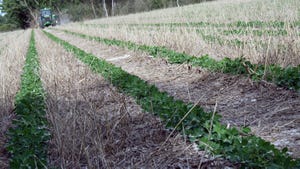
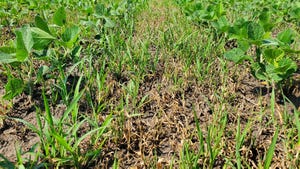
One of the most dramatic lessons from our fungicide trials was that treated rows of soybeans were not affected by untreated, completely defoliated rows next to them. Growers who treat their crop do not need to worry about the effect of neighboring fields that do not receive fungicides.

We do not know how soybean rust will affect our soybean crop in 2006. However, growers should expect the disease to be at least as bad as it was this past season. Although we do not expect soybean rust to survive the winter in Georgia due to freezing temperatures, we do expect it to continue to build in Florida.

We know it can survive on kudzu in that state during the winter. We also found Asian soybean rust on Florida beggarweed in Attapulgus this season, so the disease may also survive on this weed as well.

There is no question that the disease once again will invade Georgia in 2006. The questions now are, “How early and how much initial inoculum?” Stay tuned.

Get Copyright ClearanceWant to use this article? Click here for options!
© 2009 Penton Media, Inc.


Latest Jobs

resources

events icon events

product info icon tradeshows

tradeshow icon digests

research icon photos

Continuing Education

Accredited in Florida, Georgia, New Mexico, Oklahoma, Texas, South Carolina and Tennessee:


(New Course)
Weed Resistance Management in Cotton

This course covers a wide range of options to effectively control weeds in cotton and reduce the risk of weed resistance management. It is accredited for hours/units for licensed/accredited applicators in 7 U.S. Cotton Belt states (Florida, Georgia, New Mexico, Oklahoma, Texas, South Carolina an d Tennessee. CCA credit is pending).

(New Course)
New Mode of Action Chemistry for Vegetable Production

Integration of a new mode of action compound like Coragen into IPM and IRM programs to control Lepidoptera in leafy greens, fruiting vegetables, peppers and brassica or cole crops is always welcome. This online CE accredited course details how best to use this new mode of action insecticide in intensive vegetable production. It is accredited by the Certified Crop Adviser (CCA) program and by state agencies for licensed applicators in Texas, Georgia, Florida, New Jersey and Pennsylvania.

(New Course)
Utilizing Calcium as Nutrient That Protects Against Disease Organisms

This online accredited course focuses on Calcium, an important plant nutrient in fertilizer management for maximum, healthy plant development as well as disease and pest prevention. It is accredited by the Certified Crop Adviser (CCA) program and for licensed applicators in licensed Georgia, Florida, Pennsylvania and New Jersey. Credit applications are pending in South Carolina, Tennessee, Virginia, West Virginia and Washington.

This course is accredited in Texas, Oklahoma, New Mexico, Virginia, West Virginia and Wyoming as well as for CCA credits:

(New Course)
Spray Drift Management

Keeping crop protection chemicals on the crop for which they are intended has been a cornerstone of farming not only to protect neighboring crops, but to not waste money allowing products to drift off the intended target. This accredited online continuing education course covers the critical elements of spray drift management.

Back to Top

Browse Print Issues

Additional Resources

subscribe to Farm Press Daily Delta Farm Press Southwest Farm Press Western Farm Press