Global warming: fact or myth?

What is in this article?:

• 2011 was a year of unexpected and devastating climate extremes -- or not

• Statistics can be misleading at best, and in some cases downright confusing, as in the case of last year’s climate data.

University of Georgia photo

When it comes to a changing climate it has been said that ‘proof is in the pudding’, supposedly meaning a close examination of statistical data will quickly and clearly reveal all the facts.

But statistics can be misleading at best, and in some cases downright confusing, as in the case of last year’s climate data. 

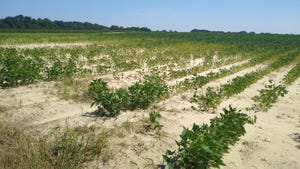
As most of us know, 2011 was a tough weather year for many U.S. farmers. Exceptional floods, historical droughts, intense and widespread incidents of wildfire, for example, are being credited with costing U.S. agriculture billions of dollars in losses last year.

But recently released climate statistics for 2011 by the National Oceanic and Atmospheric Administration’s National Climatic Data Center indicate that in spite of weather disasters that plagued large areas of the nation, temperature and rainfall averages and other relevant climate data was not significantly different than those for most years.

Or was it? You be the judge.

The average temperature last year for the contiguous U.S. was 53.8 degrees F, just one degree F above the 20th century average. In spite of the single degree difference though, 2011 is proving to be the 23rd warmest year on record. Also by contrast, precipitation across the nation last year averaged near normal, masking record-breaking extremes in both drought and flooding.

To confuse things more, globally, La Niña events helped keep the average global temperature below recent trends. As a result, 2011 tied with 1997 for the 11th warmest year on record and, surprisingly, it was the second coolest year of the 21st century to date, but tied with the second warmest year of the 20th century.

Are you confused yet?

Digging deeper into the statistical data for the U.S., it becomes apparent that while many areas suffered extreme weather, there was a balancing of extremes taking place that make 2011’s climate statistics look more normal than they actually are.

From Hot…

Warmer-than-normal temperatures were anchored across the South, Mid-Atlantic and the Northeast. Delaware had its warmest year on record, while Texas had its second warmest year on record. The U.S. has observed a long-term temperature increase of about 0.12 degrees F per decade since 1895.

Summer (June-August) 2011 was the second warmest on record for the Lower 48, with an average temperature of 74.5 degrees F, just 0.1 degree F below the record-warm summer of 1936. The epicenter of the heat was the Southern Plains, where Louisiana, New Mexico, Oklahoma and Texas all had their warmest summer on record.

Discuss this article 2

I don't see much unusual going on temperature-wise in the US overall...

http://naturalclimate.wordpress.com/2012/01/28/usa-run-and-rank-analysis/

By Michael D Smith (not verified)  on Jan 28, 2012

For a partial explanation of changes in weather,Google the word Precesson. Yes it's over a long period of time,but we don't know where we are in the cycle.Also think of a ball bearing,if its insides are are altered it won't roll correctly. we've taken oil and other materials out and shifted them all over the globe.Minute ? maybe.

By Anonymous (not verified)  on Feb 22, 2012
Post new comment
Sign In or register to use your Southeast Farm Press ID
(optional)

Continuing Education Courses
New Course

The 2,000-member Weed Science Society of America’s (WSSA) Herbicide Resistance...

New Course
The course details six of the primary diseases affecting citrus: Huanglongbing (Citrus...
Potassium nitrate has a positive effect in controlling plant pests and diseases when applied...
Farmer-to-Farmer Used Equipment