Florida study shows rice grown without paddies can feed drought-stricken communities

What is in this article?:

  • Florida study shows rice grown without paddies can feed drought-stricken communities
  • Can be lifesaver

• In some parts of the world, water is in short supply, but farmers often devote what they can to rice farming, because the crop is so important.

• However, research has led to a simple but profound solution that requires less water — growing rice in fields, a practice called aerobic rice production.

More About:

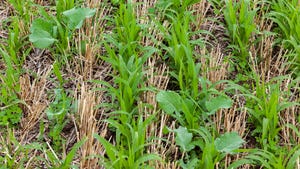
IN THIS UNDATED file photo, rice plants grow in a field in Hyderabad, India, as part of a University of Florida study. Though little-known in the West, field-grown rice, also known as aerobic rice, is gaining popularity in the Eastern Hemisphere and is often rotated with other grain crops. A new study from UF’s Institute of Food and Agricultural Sciences shows that corn plants grown after aerobic rice yield about 5 percent more grain than corn grown after paddied rice, a process requiring more elaborate soil preparation.

Photo courtesy of Rao Mylavarapu, UF/IFAS

Consumed by 3 billion people, rice is arguably the world’s most important food staple, and one reason for its popularity is that rice can be grown under flooded conditions that suppress weeds, making cultivation easier.

In some parts of the world, water is in short supply, but farmers often devote what they can to rice farming, because the crop is so important. However, research has led to a simple but profound solution that requires less water — growing rice in fields, a practice called aerobic rice production.

The practice relies on rainfall plus limited irrigation to meet the plants’ moisture needs. It requires about 40 percent less water than paddy-grown rice, according to a University of Florida study in the current issue of Agronomy Journal.

Aerobic rice production is gaining popularity in India and Southeast Asia, particularly in drought-stricken or upland areas, said Rao Mylavarapu, a professor with UF’s Institute of Food and Agricultural Sciences and one of the study’s authors.

Mylavarapu is working to address a major challenge in aerobic rice production: yield. In the two-year study, conducted in Hyderabad, India, researchers grew rice in irrigated fields and paddies. The first year’s aerobic rice harvest weighed 39 percent less than the paddy harvest; the second year the difference narrowed to 15 percent.

“Right now, there’s no way you can get the same yield under optimal conditions,” he said.

He explained that grain production is influenced by a rice plant’s ability to use nitrogen, which in turn is influenced by moisture availability. In other words, paddied plants grown in standing water have an advantage over aerobic plants receiving modest irrigation. And, the rice varieties used for paddied production are different from the ones in aerobic production.

Discuss this Article 1

Anonymous (not verified)
on Feb 7, 2013

Arkansas is a big Rice producing State. Their rice is grown in fields like Wheat, not in rows as pictured above. I am not sure the yield but it is substantial.

Post new comment
Sign In or register to use your Southeast Farm Press ID

(optional)

Continuing Education Courses
New Course
The 2,000-member Weed Science Society of America’s (WSSA) Herbicide Resistance Action...
New Course
The course details six of the primary diseases affecting citrus: Huanglongbing (Citrus...
Potassium nitrate has a positive effect in controlling plant pests and diseases when applied...

Newsletter Sign Up