Bees next big battleground for ag pesticides

What is in this article?:

It could have a significant impact on pesticides available to agriculture and how those materials are used, including a potential requirement that pesticides be applied only at night when there is no bee activity.

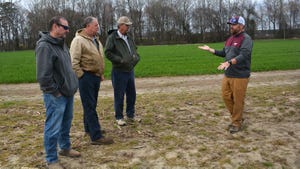
DON PARKER, from left, IPM manager, National Cotton Council, Memphis, Tenn.; Lauren Green, Green Agricultural Services, Greenwood, Miss.; and Ben Meriwether, Valent USA, Tupelo, Miss., were among those attending the annual meeting of the Mississippi Agricultural Consultants Association.

The next big battle — which could have a major impact on agricultural pesticides — is already under way.

It involves a tiny crop pollinating insect, the honeybee, and to a lesser extent its larger cousin, the bumblebee.

It could have a significant impact on pesticides available to agriculture and how those materials are used, including a potential requirement that pesticides be applied only at night when there is no bee activity.

Dead center in the initial skirmishes between beekeeper organizations, environmental groups, the EPA, pesticide manufacturers, and agriculture organizations are a number of ag pesticides, including the widely-used neonicotinoids.

Registration of a new pesticide anxiously awaited by cotton producers for plant bug control, Transform (sufloxaflor), has been slowed because the EPA, under pressure to suspend the use of neonicotinoids and other pesticides on crops with bee activity, continued to ask for additional documentation on Transform’s impact on pollinators. (It is expected that Transform will receive a full label for the 2013 crop season.)

It is estimated that bees pollinate as much as one-third of U.S. crops. They are heavily used in California, the nation’s No. 1 agricultural state; estimates are that more than half the bees in the nation are brought to California in the spring to pollinate the almond crop.

In recent years, commercial beekeepers have sustained major losses of honeybees, partly due to a disease, colony collapse disorder, the specific cause of which remains unknown. But beekeeper groups and other organizations have contended that ag pesticides are among the reasons for bee losses.

In March 2012, a group of beekeepers and honey producers, along with several anti-pesticide and food safety organizations, petitioned the EPA for an emergency suspension of the seed treatment clothianidin (trade name Poncho), claiming an “imminent hazard” to pollinators.

The agency investigated and in July 2012 said, “the EPA does not believe there is substantial likelihood of imminent serious harm from the use of clothianidin) and denied the request for suspension.

Further, it said, the petition did not demonstrate that the use of clothianidin “is causing or will cause a significant reduction in populations of domestic bees or native pollinators; significant decreases in honey production; serious effects on other agricultural systems as a result of decreases in pollination services, or a reduction in pollination of wild plants in a way that may alter ecosystems.”

Discuss this Article 0

Post new comment
Sign In or register to use your Southeast Farm Press ID
(optional)

Continuing Education Courses
New Course
The 2,000-member Weed Science Society of America’s (WSSA) Herbicide Resistance Action...
New Course
The course details six of the primary diseases affecting citrus: Huanglongbing (Citrus...
Potassium nitrate has a positive effect in controlling plant pests and diseases when applied...

Newsletter Sign Up