Custom-blend fertilizers making mark

Aug 17, 2009 9:41 AM

“It turned out to be about $50 per ton cheaper to purchase the custom blend, but the benefits didn’t stop there. The blend has a higher analysis, is easier to apply and provides the exact amounts of nutrients needed.”

The Betts brothers of Harnett County, N.C., grew up raising tobacco and, in 1991, assumed management of their father’s farm.

For years, they relied heavily on standard fertilizers they trusted, like 6-6-18 and “Bulldog soda.” Escalating prices for the first and scarce supplies of the second led them to consider switching to custom blends. Now they can’t imagine using anything else.

“In years past, fertilizer was one of the cheaper inputs in tobacco production,” said regional agronomist Don Nicholson of the North Carolina Department of Agriculture and Consumer Services. “Now it’s one of the more expensive. These fellows, and their father before them, had success with standard brands and weren’t inclined to change without good reason.”

The transition started when Ronnie Betts was preparing for his 2008 crop. Nicholson met with him to go over soil test results and pointed out that phosphorus levels were already sufficient. He suggested that Betts have a custom blend prepared that would more closely match the needs of the crop. The two men discussed the options and settled on a 10-3-22 grade fertilizer that included sulfur.

“It turned out to be about $50 per ton cheaper to purchase the custom blend, but the benefits didn’t stop there,” Betts said. “The blend has a higher analysis, is easier to apply and provides the exact amounts of nutrients needed.”

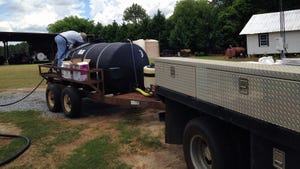
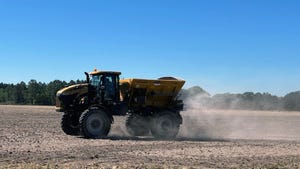
When Betts used 6-6-18, it took about 1,500 pounds of fertilizer to supply 80 to 85 units of nitrogen. He had to open around 20 bags to fill the spreader. With a custom blend, he uses only 850 pounds, and there are no bags to contend with.

“Our crop looks just as good as it did with the 6-6-18,” Betts said. “Growth is consistent from one end of the field to the other despite any difference in soil type or moisture. We’re happy with the custom blend so I don’t see going back to 6-6-18.”

Betts generally rotates tobacco with soybeans and small grain. He always submits soil samples for tobacco land several months before planting. With this management strategy, he samples about one-third of his fields each year. His soils are sandy so he almost always has to apply sulfur.

“When I get a soil report, I want Don to look at it first, then the two of us will get our heads together. I want his input. If he doesn’t have the information I need, he knows where to get it. I feel comfortable calling him at any time.”

For the past two seasons, Nicholson has helped Betts decide on a custom-blend analysis based on soil test results. In other years, Nicholson has helped Betts work out the fertilization for float bed production of tobacco transplants and diagnose growth problems based on tissue test results.

“One of my next goals is to show them how to optimize the timing of harvest by using tissue samples,” Nicholson said.

“We’re always looking for ways to improve, and it seems to pay off,” Betts said. “Recently, we’ve increased our acreage and added 15 new bulk barns. I’m open to Don’s suggestions.”

North Carolina growers have access to one of the most comprehensive agronomic testing and advisory services in the nation. Soil testing and agronomic consulting through NCDA&CS are provided free of charge for North Carolina residents. Other agronomic tests — nematode assay and plant, waste or solution analyses — are available to residents for minimal fees and to non-residents for slightly higher fees. Information on other tests is available online at http://www.ncagr.gov/agronomi/sampleinfo.htm.

The NCDA&CS Field Services Section has helped North Carolina growers manage fertilization and other nutrient-related issues for nearly 30 years. The division’s 13 regional agronomists make site visits; evaluate suspected nutrient and/or nematode problems; and give advice on sampling, liming and fertilization. For contact information, go to http://www.ncagr.gov/agronomi/rahome.htm.

Agronomist Don Nicholson serves growers in Harnett, Johnston, Wake, Wayne and Wilson counties. He can be reached by phone at (919) 498-0504 or by e-mail at don.nicholson@ncagr.gov.

Get Copyright ClearanceWant to use this article? Click here for options!
© 2010 Penton Media, Inc.


Latest Jobs

resources

events icon events

product info icon tradeshows

tradeshow icon digests

research icon photos

Continuing Education

Accredited in Florida, Georgia, New Mexico, Oklahoma, Texas, South Carolina and Tennessee:


(New Course)
Weed Resistance Management in Cotton

This course covers a wide range of options to effectively control weeds in cotton and reduce the risk of weed resistance management. It is accredited for hours/units for licensed/accredited applicators in 7 U.S. Cotton Belt states (Florida, Georgia, New Mexico, Oklahoma, Texas, South Carolina an d Tennessee. CCA credit is pending).

(New Course)
New Mode of Action Chemistry for Vegetable Production

Integration of a new mode of action compound like Coragen into IPM and IRM programs to control Lepidoptera in leafy greens, fruiting vegetables, peppers and brassica or cole crops is always welcome. This online CE accredited course details how best to use this new mode of action insecticide in intensive vegetable production. It is accredited by the Certified Crop Adviser (CCA) program and by state agencies for licensed applicators in Texas, Georgia, Florida, New Jersey and Pennsylvania.

(New Course)
Utilizing Calcium as Nutrient That Protects Against Disease Organisms

This online accredited course focuses on Calcium, an important plant nutrient in fertilizer management for maximum, healthy plant development as well as disease and pest prevention. It is accredited by the Certified Crop Adviser (CCA) program and for licensed applicators in licensed Georgia, Florida, Pennsylvania and New Jersey. Credit applications are pending in South Carolina, Tennessee, Virginia, West Virginia and Washington.

This course is accredited in Texas, Oklahoma, New Mexico, Virginia, West Virginia and Wyoming as well as for CCA credits:

(New Course)
Spray Drift Management

Keeping crop protection chemicals on the crop for which they are intended has been a cornerstone of farming not only to protect neighboring crops, but to not waste money allowing products to drift off the intended target. This accredited online continuing education course covers the critical elements of spray drift management.

New Course
The ABCs of MRLs

American agriculture exports 20 to 30 percent of its production annually. For specific commodities, the percentage is much higher. When recommending and applying pest management products for crops, license Pest Control Advisers (PCAs)  and applicators and farmers must be aware of which products applied are in compliance with Maximum Residue Limits (MRLs) established by foreign customers. This CE course details the MRL issue and why compliance is critical to marketing into world trade.

Back to Top

Browse Print Issues

Additional Resources

subscribe to Farm Press Daily Delta Farm Press Southwest Farm Press Western Farm Press