Farmers should brace themselves for a continuation of "Water Wars"

Mar 6, 2008 9:59 AM, By Paul L. Hollis
Farm Press Editorial Staff

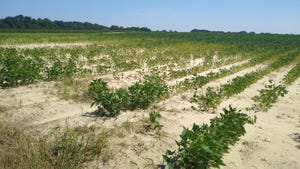
Farmers in the Southeast have had plenty to contend with in the past year or so with the ravages of what some are calling the “all-time” worst drought. Others have preferred to classify it as a “100-year” drought, but if you’re trying to survive it, the terminology doesn’t matter — it has been bad.

But now it’s about to become really interesting, as the various states and the politicians start to weigh in with their solutions. In other words, brace yourselves for a flurry of regulations the likes of which you’ve never seen, at least when it comes to water use.

For the most part, legislators have sat on their hands, not paying much if any attention to the effects of drought on their respective states. But in Georgia, limited water resources are beginning to impact the future growth of Atlanta. And in Alabama, the problem could affect the operation of a nuclear power plant.

So suddenly, it’s a priority issue for our duly elected leaders. This is not to say that it shouldn’t be a priority issue — it’s just that it should have become one long before now.

In Georgia, the General Assembly has passed a statewide water-use plan, but questions remain about how it will be funded and how it will be implemented. Alabama is just beginning the process, with Gov. Bob Riley saying recently that his state will conduct a statewide assessment of all water resources, above and below ground. This, he says, is the first step in creating a statewide water policy.

“It is believed we have up to 10 times the amount of water underground as we do above ground in our reservoirs,” said Riley in his Sate of the State address. “Our ability to tap into these underground reservoirs could solve so many problems, and I can think of no better mission than protecting our state from the ravages of the next drought.”

But before any of the states get very far in their water planning, there’s still the matter of the 18-years-long “Water Wars” to be settled among Alabama, Florida and Georgia. You may recall that the governors of the three states met in Washington, D.C., late last year with the U.S. Army Corps of Engineers and pledged to work together and “play nice” to try and reach some sort of compromise.

That was then, and this is now. A federal appeals court recently threw out an agreement that Georgia had reached with the Corps of Engineers for water rights to a major federal reservoir outside Atlanta, handing Alabama and Florida a major victory in the states’ years-long water wars.

The 2003 agreement with the Corps would give Georgia about a quarter of Lake Lanier’s capacity during the coming decades and is the foundation of Georgia’s long-term plans for supplying drinking water to the rapidly growing Atlanta region.

Alabama and Florida challenged the pact, arguing Georgia doesn’t have a legal right to the federal reservoir, which was initially built for hydropower. A district court earlier ruled in Georgia’s favor, but the U.S. Court of Appeals in Washington overturned that decision, saying the agreement constituted a major operational change at the reservoir that requires congressional approval.

The decision appears to have emboldened Alabama’s Gov. Riley, who laid down the gauntlet in February, saying, “There are some in Georgia who believe the water in those federal reservoirs belongs only to Georgians. However, Georgia didn’t build those reservoirs and Georgia didn’t pay for them. No. They were built with federal dollars, which means Alabama helped build them, Alabama helped pay for them, and Alabama has as much right to them as Georgia has ever had or ever will have. So let our message be heard loud and clear in Atlanta and in Washington: Alabama will never give up our right to the water in those reservoirs.”

Riley also chided Georgia for its lack of conservation efforts as the drought developed this summer. For example, he noted that Georgia did not impose a ban on outdoor watering until the end of summer.

“Atlanta can’t spend all summer during a drought watering their lawns and flowers and then expect someone else to bail them out,” he said.

Doesn’t sound much like someone seeking to strike a compromise.

More than one expert has likened the collapse of the region’s water resources to a natural disaster waiting to happen.

“This whole situation has been like Katrina in slow motion,” says David Goldberg, a “smart growth” advocate and Atlanta-based writer on urban affairs. “It’s the same confluence of factors. There’s Mother Nature, the Army Corps of Engineers and the utter failure to plan for the growth of metro Atlanta.”

Where farmers will fit into this as we move forward is anybody’s guess.

e-mail: phollis@farmpress.com

Get Copyright ClearanceWant to use this article? Click here for options!
© 2009 Penton Media, Inc.


Latest Jobs

resources

events icon events

product info icon tradeshows

tradeshow icon digests

research icon photos

Continuing Education

Accredited in Florida, Georgia, New Mexico, Oklahoma, Texas, South Carolina and Tennessee:


(New Course)
Weed Resistance Management in Cotton

This course covers a wide range of options to effectively control weeds in cotton and reduce the risk of weed resistance management. It is accredited for hours/units for licensed/accredited applicators in 7 U.S. Cotton Belt states (Florida, Georgia, New Mexico, Oklahoma, Texas, South Carolina an d Tennessee. CCA credit is pending).

(New Course)
New Mode of Action Chemistry for Vegetable Production

Integration of a new mode of action compound like Coragen into IPM and IRM programs to control Lepidoptera in leafy greens, fruiting vegetables, peppers and brassica or cole crops is always welcome. This online CE accredited course details how best to use this new mode of action insecticide in intensive vegetable production. It is accredited by the Certified Crop Adviser (CCA) program and by state agencies for licensed applicators in Texas, Georgia, Florida, New Jersey and Pennsylvania.

(New Course)
Utilizing Calcium as Nutrient That Protects Against Disease Organisms

This online accredited course focuses on Calcium, an important plant nutrient in fertilizer management for maximum, healthy plant development as well as disease and pest prevention. It is accredited by the Certified Crop Adviser (CCA) program and for licensed applicators in licensed Georgia, Florida, Pennsylvania and New Jersey. Credit applications are pending in South Carolina, Tennessee, Virginia, West Virginia and Washington.

This course is accredited in Texas, Oklahoma, New Mexico, Virginia, West Virginia and Wyoming as well as for CCA credits:

(New Course)
Spray Drift Management

Keeping crop protection chemicals on the crop for which they are intended has been a cornerstone of farming not only to protect neighboring crops, but to not waste money allowing products to drift off the intended target. This accredited online continuing education course covers the critical elements of spray drift management.

Back to Top

Browse Print Issues

Additional Resources

subscribe to Farm Press Daily Delta Farm Press Southwest Farm Press Western Farm Press