ASA appreciates EPA offer to clarify dust issue

Oct 27, 2006 10:06 AM

The American Soybean Association (ASA) has expressed appreciation that U.S. Environmental Protection Agency (EPA) Administrator Stephen Johnson has offered to send a letter to the states clarifying that a new EPA rule does not change the existing status of agricultural dust regulations.

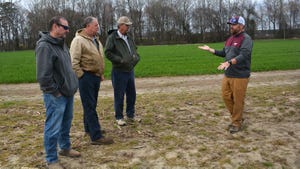
Johnson offered the letter during a visit to the Perry, Iowa, farm of ASA past-President Ron Heck. The top EPA official was invited to meet with Senator Chuck Grassley (R-Iowa) to listen to producers’ concerns about EPA’s proposed dust control regulations.

Grassley requested the meeting because EPA did not include an exemption for agricultural sources of dust, as was proposed earlier by the agency, when EPA recently announced revisions to the National Ambient Air Quality Standards, which address fine and course particle pollution.

Instead, the agency included some additional information in the preamble that says agricultural sources shall not be subject to meeting the proposed standards. Johnson said EPA cannot put an exemption in the rule because Congress does not allow them to include exemptions.

Johnson emphasized that no new rules have been imposed on agriculture. "We want to make it clear that we see agriculture as a producer of solutions, not problems," he said. "Our concern is focused on urban and industrial sources of coarse particulate matter. We don’t want to regulate dirt — we don’t think it’s the right thing for the EPA to do."

Grassley expressed concern that state agencies might feel compelled to enforce the rules differently, disregarding EPA’s intent, which he maintains puts farmers in jeopardy. Farmers at the meeting were concerned about being exposed to lawsuits because they aren’t exempt from the regulations.

Heck, who is also a director of the Iowa Soybean Association (ISA), said he was comfortable with Johnson’s intentions, but without an exemption for farmers in the rule, there are no guarantees against lawsuits.

"I’m still concerned about the application of this somewhere down the road, someone taking it out of context and interpreting the rule and using it as an excuse to sue a farmer over dust even though EPA does not intend this rule to cover farm dust," Heck said.

"But Administrator Johnson did agree he would send a letter to the states clarifying the new rule does not change the existing status of agricultural dust regulations."

ISA President Ray Gaesser told Johnson, "We need a very clear statement about your position on agricultural particulate matter, both for livestock and crop farmers, to protect us from lawsuits. Even if a lawsuit is frivolous, it can break a farmer while he fights it."

Heck said, "Soybean farmers also appreciate Senator Grassley’s leadership on this issue, and support his requests that the Senate Environment and Public Works Committee hold a hearing on the revised final EPA rule and that USDA’s Economic Research Service study the economic impact this rule could have on agriculture."

Get Copyright ClearanceWant to use this article? Click here for options!
© 2010 Penton Media, Inc.


Latest Jobs

Subscribe to RSS headline updates from:
Powered by FeedBurner

Continuing Education

Accredited in Florida, Georgia, New Mexico, Oklahoma, Texas, South Carolina and Tennessee:


(New Course)
Weed Resistance Management in Cotton

This course covers a wide range of options to effectively control weeds in cotton and reduce the risk of weed resistance management. It is accredited for hours/units for licensed/accredited applicators in 7 U.S. Cotton Belt states (Florida, Georgia, New Mexico, Oklahoma, Texas, South Carolina an d Tennessee. CCA credit is pending).

(New Course)
New Mode of Action Chemistry for Vegetable Production

Integration of a new mode of action compound like Coragen into IPM and IRM programs to control Lepidoptera in leafy greens, fruiting vegetables, peppers and brassica or cole crops is always welcome. This online CE accredited course details how best to use this new mode of action insecticide in intensive vegetable production. It is accredited by the Certified Crop Adviser (CCA) program and by state agencies for licensed applicators in Texas, Georgia, Florida, New Jersey and Pennsylvania.

(New Course)
Utilizing Calcium as Nutrient That Protects Against Disease Organisms

This online accredited course focuses on Calcium, an important plant nutrient in fertilizer management for maximum, healthy plant development as well as disease and pest prevention. It is accredited by the Certified Crop Adviser (CCA) program and for licensed applicators in licensed Georgia, Florida, Pennsylvania and New Jersey. Credit applications are pending in South Carolina, Tennessee, Virginia, West Virginia and Washington.

This course is accredited in Texas, Oklahoma, New Mexico, Virginia, West Virginia and Wyoming as well as for CCA credits:

(New Course)
Spray Drift Management

Keeping crop protection chemicals on the crop for which they are intended has been a cornerstone of farming not only to protect neighboring crops, but to not waste money allowing products to drift off the intended target. This accredited online continuing education course covers the critical elements of spray drift management.

New Course
The ABCs of MRLs

American agriculture exports 20 to 30 percent of its production annually. For specific commodities, the percentage is much higher. When recommending and applying pest management products for crops, license Pest Control Advisers (PCAs)  and applicators and farmers must be aware of which products applied are in compliance with Maximum Residue Limits (MRLs) established by foreign customers. This CE course details the MRL issue and why compliance is critical to marketing into world trade.

Back to Top

Browse Print Issues

Additional Resources

subscribe to Farm Press Daily Delta Farm Press Southwest Farm Press Western Farm Press