Pigweed not only threat to glyphosate resistance

Oct 19, 2006 9:54 AM, By Roy Roberson
Farm Press Editorial Staff

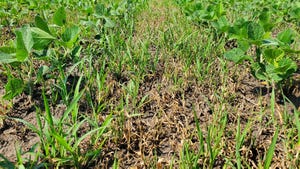
Though Palmer amaranth, commonly called Palmer pigweed, is the most pressing weed resistance problem for farmers from the Midwest to the Southeast, it is not the only weed showing resistance to glyphosate.

The first glyphosate resistant weed to create problems was horseweed, sometimes called marestail. Horseweed resistance was first found in the Carolinas in 2003, and it continues to be a problem. “Each year we find a little bit more — it is wide-spread all up and down the Coastal Plain of North Carolina,” says Alan York, long-time North Carolina State University weed specialist.

In 2006, glyphosate resistant common ragweed was reported in a handful of counties in North Carolina. “High rates of Weathermax uglied-up the terminal, but the ragweed didn’t die,” York says. He explains that to document resistance, there has to be proof that the resistant trait is heritable.

Giant ragweed is being investigated in Indiana, with distinct signs that it has developed resistance to glyphosate. Resistant giant ragweed would be a problem comparable to Palmer amaranth in some parts of the country.

Common ragweed is not likely to be a big problem for growers in the Carolinas and Virginia, according to York. The biggest problem may be in no-till or reduced-till systems which require a clean field to plant cotton. In these systems the problem is what to use for burn-down. If ragweed is resistant to glyphosate, the options are limited to dicamba, paraquat and 2,4-D.

Researchers in South Carolina have found glyphosate resistant cocklebur, and are in the process of documenting for certain that it is resistant. Clemson researchers are still conducting greenhouse tests, but the evidence is strong that at least one cotton field in South Carolina has glyphosate resistant cocklebur.

Virginia Tech researchers are at a similar place in time in documenting glyphosate resistant lambsquarters. More of a problem in the upper end of the Southeast, lambsquarters, prior to the introduction of Roundup Ready technology, was a constant problem in a number of row crops.

e-mail: rroberson@farmpress.com

Get Copyright ClearanceWant to use this article? Click here for options!
© 2009 Penton Media, Inc.


Latest Jobs

resources

events icon events

product info icon tradeshows

tradeshow icon digests

research icon photos

Continuing Education

Accredited in Florida, Georgia, New Mexico, Oklahoma, Texas, South Carolina and Tennessee:


(New Course)
Weed Resistance Management in Cotton

This course covers a wide range of options to effectively control weeds in cotton and reduce the risk of weed resistance management. It is accredited for hours/units for licensed/accredited applicators in 7 U.S. Cotton Belt states (Florida, Georgia, New Mexico, Oklahoma, Texas, South Carolina an d Tennessee. CCA credit is pending).

(New Course)
New Mode of Action Chemistry for Vegetable Production

Integration of a new mode of action compound like Coragen into IPM and IRM programs to control Lepidoptera in leafy greens, fruiting vegetables, peppers and brassica or cole crops is always welcome. This online CE accredited course details how best to use this new mode of action insecticide in intensive vegetable production. It is accredited by the Certified Crop Adviser (CCA) program and by state agencies for licensed applicators in Texas, Georgia, Florida, New Jersey and Pennsylvania.

(New Course)
Utilizing Calcium as Nutrient That Protects Against Disease Organisms

This online accredited course focuses on Calcium, an important plant nutrient in fertilizer management for maximum, healthy plant development as well as disease and pest prevention. It is accredited by the Certified Crop Adviser (CCA) program and for licensed applicators in licensed Georgia, Florida, Pennsylvania and New Jersey. Credit applications are pending in South Carolina, Tennessee, Virginia, West Virginia and Washington.

This course is accredited in Texas, Oklahoma, New Mexico, Virginia, West Virginia and Wyoming as well as for CCA credits:

(New Course)
Spray Drift Management

Keeping crop protection chemicals on the crop for which they are intended has been a cornerstone of farming not only to protect neighboring crops, but to not waste money allowing products to drift off the intended target. This accredited online continuing education course covers the critical elements of spray drift management.

Back to Top

Browse Print Issues

Additional Resources

subscribe to Farm Press Daily Delta Farm Press Southwest Farm Press Western Farm Press