Pigweed resistance a nightmare for Carolina grower

Sep 27, 2006 8:16 AM, By Roy Roberson
Farm Press Editorial Staff

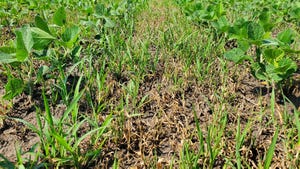
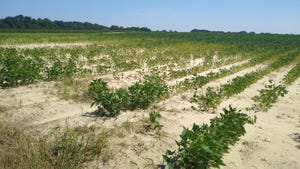
Bill McGoogan, who farms near Lumber Bridge, N.C., first noticed some pigweed in one of his soybean fields that had been sprayed with glyphosate. He went back and sprayed it again with glyphosate, making sure to get good coverage.

“The second time I sprayed it, I knew I had good coverage and nothing happened with the pigweed. I called Monsanto, and they came and sprayed a 3X and a 6X rate of Weathermax, and it still had little effect” the North Carolina farmer says.

In 2005, McGoogan says he didn’t see any other real bad spots, though there were Palmer pigweed escapes throughout his farm. Pigweed escapes are not at all uncommon, and he couldn’t pinpoint for certain that any of these were caused by herbicide resistance.

After finding the resistant pigweed in his soybeans, McGoogan began noticing patches of weeds in neighboring fields.

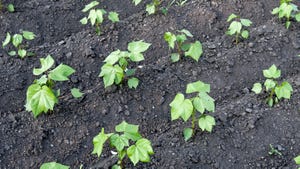
In 2006, the resistant pigweed spread to cotton and soybean fields. On cotton, he used 24 ounces per acre of Weathermax, plus 1.7 pints of Staple. When that didn’t control the pigweed, he put on a second application of 24 ounces of Weathermax, and did not control the weeds.

Already looking toward the 2007 season, McGoogan tried three different combinations of pre-plant, residual herbicides in test plots on his farm. His goal is to help keep pigweed under control for 4 or 5 weeks after cotton is planted. In these test plots, he used Prowl alone, Reflex alone, and Prowl plus a pint of Direx.

The best combination, he says, was Prowl H20, and he got similar results with Prowl plus a pint of Direx, Prowl alone cost $4-5 per acre and a pint of Direx adds another $2 to the tab. Reflex did not perform as well in McGoogan’s test and cost about $11 per acre.

In the 2006 test, the North Carolina farmer said conditions were nearly perfect for using a pre-plant material. Adequate rainfall after he applied the test plots of Prowl, Prowl plus Direx and Reflex gave each material the opportunity to work.

A big knock on pendamethalin, which Prowl is one of a number of herbicides available, is failure to work properly without adequate moisture

In 2007, McGoogan says he will probably go back to more cultivation, use pre-plant residual herbicides, most likely Prowl, then come back at the four leaf stage and apply Weathermax. Within a week or so after applying Weathermax, he will likely come back and cultivate and use a post-directed spray, probably Cotoran and MSMA.

For farmers who document cases of resistance on the farms, he says, plan on the problem getting much bigger the following year. “I thought, maybe it won’t carry through from one year to the next, but it does. If you see an isolated area this year, you better count on it being a quarter or half the field the next year,” he says.

e-mail: rroberson@farmpress.com

Get Copyright ClearanceWant to use this article? Click here for options!
© 2009 Penton Media, Inc.


Latest Jobs

resources

events icon events

product info icon tradeshows

tradeshow icon digests

research icon photos

Continuing Education

Accredited in Florida, Georgia, New Mexico, Oklahoma, Texas, South Carolina and Tennessee:


(New Course)
Weed Resistance Management in Cotton

This course covers a wide range of options to effectively control weeds in cotton and reduce the risk of weed resistance management. It is accredited for hours/units for licensed/accredited applicators in 7 U.S. Cotton Belt states (Florida, Georgia, New Mexico, Oklahoma, Texas, South Carolina an d Tennessee. CCA credit is pending).

(New Course)
New Mode of Action Chemistry for Vegetable Production

Integration of a new mode of action compound like Coragen into IPM and IRM programs to control Lepidoptera in leafy greens, fruiting vegetables, peppers and brassica or cole crops is always welcome. This online CE accredited course details how best to use this new mode of action insecticide in intensive vegetable production. It is accredited by the Certified Crop Adviser (CCA) program and by state agencies for licensed applicators in Texas, Georgia, Florida, New Jersey and Pennsylvania.

(New Course)
Utilizing Calcium as Nutrient That Protects Against Disease Organisms

This online accredited course focuses on Calcium, an important plant nutrient in fertilizer management for maximum, healthy plant development as well as disease and pest prevention. It is accredited by the Certified Crop Adviser (CCA) program and for licensed applicators in licensed Georgia, Florida, Pennsylvania and New Jersey. Credit applications are pending in South Carolina, Tennessee, Virginia, West Virginia and Washington.

This course is accredited in Texas, Oklahoma, New Mexico, Virginia, West Virginia and Wyoming as well as for CCA credits:

(New Course)
Spray Drift Management

Keeping crop protection chemicals on the crop for which they are intended has been a cornerstone of farming not only to protect neighboring crops, but to not waste money allowing products to drift off the intended target. This accredited online continuing education course covers the critical elements of spray drift management.

Back to Top

Browse Print Issues

Additional Resources

subscribe to Farm Press Daily Delta Farm Press Southwest Farm Press Western Farm Press