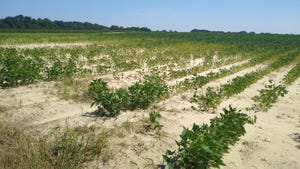
New cases of Asian soybean rust continue to surface in Southeast

Aug 26, 2005 2:26 PM, By David Bennett, Farm Press Editorial Staff

While still not in a gallop across the Southeast, the week of Aug. 22 saw Asian soybean rust move from a walk to a canter.

On Aug. 24, new soybean rust sites were confirmed in six Alabama counties: in soybean sentinel plots in Coffee and Henry counties; in commercial soybean fields in Houston, Dale and Pike counties; and on kudzu in Conecuh and Pike counties. Conecuh County is in south-central Alabama with all the other listed counties in the southeast.

“Infected beans in the sentinel plots and fields were at R-3 to R-6,” said Ed Sikora, Alabama Extension plant pathologist on Thursday afternoon. “Generally, the infection level seems low. However, I’m only walking a small percentage of the commercial fields. Some of these fields are 60 acres-plus in size. I believe incidence is ‘low to very low’ but could easily be missing hot spots within fields.”

In Georgia, rust continued its dogged northward trek.

On Aug. 22, soybean rust was confirmed for the first time in a commercial soybean field in Appling County at R-3/R-4. A day later, rust was found in sentinel plots at the Rural Development Center in Tifton.

On Aug. 24, new cases of soybean rust were confirmed in two research farm sentinel plots in Grady and Oconee counties. The Oconee County site, near Athens, is the farthest north that soybean rust has been found in the state.

On Aug. 26, a Putnam County sentinel plot — near Eatonton — was the next rust site confirmed. Pustules were found on 82 percent of the leaves collected from the plot’s Group II, III and IV plants. On the plot’s Group VII R-3 plants, 19 percent of the collected leaves were infected.

“The biggest surprise we’ve had is the way rust has progressed,” Bob Kemerait, Georgia Extension plant pathologist, said Friday morning. “It seems to be traveling around 60 to 70 miles per week. Once it got going, we were prepared for rust to be devastating. It hasn’t acted like that. It has spread across the state but hasn’t destroyed any fields.”

Both Sikora and Kemerait suspect the disease is more widespread than the sites found.

“It’s got to be in a lot more commercial fields than we know,” said Kemerait. “The rust spread has been so slow a lot of producers don’t even know it’s there.

“My feeling is we’re having little amounts of spores come in to start infection. That’s opposed to an overwhelming amount of spores moving in and infecting everything at once. In Brazil, there are huge spore showers that lead to rapid rust infections. Here, that isn’t happening.

“I’ll go so far as to say this: if we didn’t have sentinel plots and weren’t looking really hard for rust, I wouldn’t have guessed it was in the state.”

The disease remains difficult to detect in Alabama as well.

“When I’m out there checking for rust, I stumble across it — maybe because I’m more familiar with it,” said Sikora. “But it still isn’t at the point where you can pull up, get out of the truck and find it immediately at the edge of a field. I still have to get out and search hard. Finding it remains a mix of persistence and luck.”

How is Sikora picking commercial fields to check?

“In certain areas, every one I see, I’ll look at. We only have 160,000 soybean acres in Alabama so in some counties I try to get directions from Extension agents to areas with fields. In other cases, I’ll see soybeans while driving by and simply pull over and check them.”

Sikora is very curious about kudzu’s relationship with soybean rust. How chief a role the alternative host is playing in the rust’s spread is undetermined.

“There’s a tremendous amount of kudzu out there. Over the last two days, I was able to find rust in two kudzu patches out of a dozen I checked at random.

“Here’s the thing: I’m checking kudzu that’s accessible from the road. When you think about how much kudzu is off the road, though, it’s kind of overwhelming. There are acres upon acres of kudzu that’s going unchecked and could be acting as a host for rust.”

Sikora said it doesn’t appear soybean rust develops as rapidly on kudzu as it does on beans. “The pustules and sporalation appears to be much less on kudzu.”

Last year was supposedly the first for soybean rust in the United States. Assuming that timeline is correct, there were only a few months for soybean rust to over-winter in Florida.

“This year, we’ll have a full season worth of rust,” said Kemerait. “As a result, Florida’s kudzu may have loaded up with rust for the first time. That may mean a lot more innoculum starting off next year. If that’s the case, then this year we had perfect rust conditions but little innoculum. Next year, though, as rust continues to build in Florida and the Caribbean, we may see earlier and stronger infection.”

e-mail: dbennett@primedibusiness.com

Get Copyright ClearanceWant to use this article? Click here for options!
© 2010 Penton Media, Inc.


Latest Jobs

Subscribe to RSS headline updates from:
Powered by FeedBurner

Continuing Education

Accredited in Florida, Georgia, New Mexico, Oklahoma, Texas, South Carolina and Tennessee:


(New Course)
Weed Resistance Management in Cotton

This course covers a wide range of options to effectively control weeds in cotton and reduce the risk of weed resistance management. It is accredited for hours/units for licensed/accredited applicators in 7 U.S. Cotton Belt states (Florida, Georgia, New Mexico, Oklahoma, Texas, South Carolina an d Tennessee. CCA credit is pending).

(New Course)
New Mode of Action Chemistry for Vegetable Production

Integration of a new mode of action compound like Coragen into IPM and IRM programs to control Lepidoptera in leafy greens, fruiting vegetables, peppers and brassica or cole crops is always welcome. This online CE accredited course details how best to use this new mode of action insecticide in intensive vegetable production. It is accredited by the Certified Crop Adviser (CCA) program and by state agencies for licensed applicators in Texas, Georgia, Florida, New Jersey and Pennsylvania.

(New Course)
Utilizing Calcium as Nutrient That Protects Against Disease Organisms

This online accredited course focuses on Calcium, an important plant nutrient in fertilizer management for maximum, healthy plant development as well as disease and pest prevention. It is accredited by the Certified Crop Adviser (CCA) program and for licensed applicators in licensed Georgia, Florida, Pennsylvania and New Jersey. Credit applications are pending in South Carolina, Tennessee, Virginia, West Virginia and Washington.

This course is accredited in Texas, Oklahoma, New Mexico, Virginia, West Virginia and Wyoming as well as for CCA credits:

(New Course)
Spray Drift Management

Keeping crop protection chemicals on the crop for which they are intended has been a cornerstone of farming not only to protect neighboring crops, but to not waste money allowing products to drift off the intended target. This accredited online continuing education course covers the critical elements of spray drift management.

New Course
The ABCs of MRLs

American agriculture exports 20 to 30 percent of its production annually. For specific commodities, the percentage is much higher. When recommending and applying pest management products for crops, license Pest Control Advisers (PCAs)  and applicators and farmers must be aware of which products applied are in compliance with Maximum Residue Limits (MRLs) established by foreign customers. This CE course details the MRL issue and why compliance is critical to marketing into world trade.

Back to Top

Browse Print Issues

Additional Resources

subscribe to Farm Press Daily Delta Farm Press Southwest Farm Press Western Farm Press