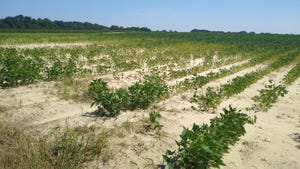
Asian soybean rust found in Georgia sentinel plot

Jul 18, 2005 9:54 PM, By David Bennett

Asian soybean rust has been found in a sentinel plot at the University of Georgia Coastal Plain Experiment Station in Tifton. Layla Sconyers, a plant pathology research associate, collected samples from the plot last Friday, according to Georgia researchers.

Rust was also reported today in George County in southeast Mississippi. Mississippi State University Extension specialists said the discovery was in an area removed from the state's main soybean growing region.

“Because of the large number of samples, they’ve only been checked today,” said Bob Kemerait, Georgia Extension plant pathologist Monday, of the Georgia finding. “Out of 100 leaves pulled, there was one leaf (from a plant at R-5) that had five or six pustules on it. Layla did a great job. She caught it very early in the infection.”

Rust hasn’t been found anywhere else in the state.

Further tests will be run on the sample. “However, there’s no doubt in my mind it’s rust,” said Kemerait.

The good news is the infestation is “very low. I went out to the plot tonight and there are a lot more bacterial pustules than anything that could be rust.”

Even so, Kemerait is troubled with where the rust was picked up. “I thought if rust was found in Georgia, it would be in the southern part of the state: maybe Seminole County, coming out of Alabama. Tifton, in Tift County, is in the heart of the coastal plain, right on I-75 about 65 miles north of the Florida line.

“Unfortunately, if we’ve got rust here, I can’t tell growers anywhere on the coastal plain they’re safe from it. For that reason, I’m calling for growers in the area who have reached bloom stage, or beyond, to go ahead a spray a fungicide. I hate to break the news, but growers need to consider spraying. It’s time.”

Kemerait said conventional wisdom says the rust came in with Hurricane Dennis. The traditional rust development timeline doesn’t fit that, though.

“It was found last Friday. Dennis hit six days earlier. It’s hard to believe it had enough time to come in and get going in that amount of time. I guess it’s possible, but it would have had to hustle. Usually it takes well over a week for rust to reach that point.”

Mississippi State specialists said the isolation of the plot in their state heightens the need for scouting vigilance but doesn’t warrant new fungicide spraying recommendations.

“I found the rust in a plot of Group 5s in George County last Wednesday evening (July 13), late,” said Billy Moore, Mississippi Extension plant pathologist. “There aren’t many beans in George County. That remains the only spot in the state we’ve found any rust.”

What Moore found was “just symptoms, nothing obvious. I pull samples all the time based on ‘symptoms.’ Often, it’s just herbicide damage or something. This time, it happened to be rust.”

Moore placed the samples in a plastic bag and that in a cooler.

“There’s no ice in the cooler, the temperature stays 70 to 80 degrees. The sample stayed in the cooler until Friday night when I got back to (Starkville, Miss.) after a scouting trip. The samples were put in the fridge until they were looked at in the lab today.”

“As hard as Billy has been looking for this, I’m glad it was him who found it,” said Alan Blaine, state Extension soybean specialist. “It’s been harder than looking for a needle in a haystack. Even in this instance, he pulled 14 leaves and found rust on one.”

Both men cautioned producers in Mississippi against quick action with fungicides for rust alone. However, with other yield-sapping diseases like Cercospora and frogeye showing up, producers shouldn’t assume fungicides aren’t needed at all.

“We can make money protecting our crop from things other than rust,” said Blaine. “Fungicides are good for maintaining soybean yields whether rust is around or not. Producers don’t need to forget that.”

Moore said his discovery involved “an extremely small amount of rust. It’s well away from soybean production areas. We monitor sentinel plots around Jackson, Ala., frequently. Rust hasn’t been found there. There are a few soybeans in the Meadville, Miss., area, a few beans in Poplarville, and a couple of other fields scattered around. Around there, beans are very, very sparse. There are so few bean producers there you can count them on two hands.” Alerted to the rust find in Alabama (near Mobile) last week, several of the aforementioned producers have already sprayed fungicides.

“We’ll be back in George County checking things tomorrow,” said Moore. “Certainly, if soybean rust develops in the plot to any extent, we’ll destroy it. The main news is this: we’re not concerned this poses a major threat to producers further north.

“Right now, there’s no reason for producers to be alarmed about this. No one should be losing sleep. We’re watching this closely. It isn’t a situation where there’s a wave of spores rolling north. There are so few spores being distributed, right now. It’s like dropping a few grains of sand in the ocean.”

e-mail: dbennett@primediabusiness.com

Get Copyright ClearanceWant to use this article? Click here for options!
© 2009 Penton Media, Inc.


Latest Jobs

resources

events icon events

product info icon tradeshows

tradeshow icon digests

research icon photos

Continuing Education

Accredited in Florida, Georgia, New Mexico, Oklahoma, Texas, South Carolina and Tennessee:


(New Course)
Weed Resistance Management in Cotton

This course covers a wide range of options to effectively control weeds in cotton and reduce the risk of weed resistance management. It is accredited for hours/units for licensed/accredited applicators in 7 U.S. Cotton Belt states (Florida, Georgia, New Mexico, Oklahoma, Texas, South Carolina an d Tennessee. CCA credit is pending).

(New Course)
New Mode of Action Chemistry for Vegetable Production

Integration of a new mode of action compound like Coragen into IPM and IRM programs to control Lepidoptera in leafy greens, fruiting vegetables, peppers and brassica or cole crops is always welcome. This online CE accredited course details how best to use this new mode of action insecticide in intensive vegetable production. It is accredited by the Certified Crop Adviser (CCA) program and by state agencies for licensed applicators in Texas, Georgia, Florida, New Jersey and Pennsylvania.

(New Course)
Utilizing Calcium as Nutrient That Protects Against Disease Organisms

This online accredited course focuses on Calcium, an important plant nutrient in fertilizer management for maximum, healthy plant development as well as disease and pest prevention. It is accredited by the Certified Crop Adviser (CCA) program and for licensed applicators in licensed Georgia, Florida, Pennsylvania and New Jersey. Credit applications are pending in South Carolina, Tennessee, Virginia, West Virginia and Washington.

This course is accredited in Texas, Oklahoma, New Mexico, Virginia, West Virginia and Wyoming as well as for CCA credits:

(New Course)
Spray Drift Management

Keeping crop protection chemicals on the crop for which they are intended has been a cornerstone of farming not only to protect neighboring crops, but to not waste money allowing products to drift off the intended target. This accredited online continuing education course covers the critical elements of spray drift management.

Back to Top

Browse Print Issues

Additional Resources

subscribe to Farm Press Daily Delta Farm Press Southwest Farm Press Western Farm Press