Georgia drought conditions worsen

May 30, 2007 10:51 AM, By David Emory Stooksbury
University of Georgia

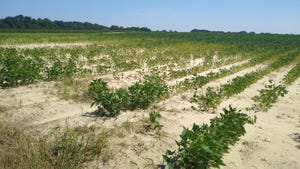
Drought conditions continue to worsen across the entire state. Of Georgia's 159 counties, 74 are classified as being in extreme drought, 79 in severe drought and six in moderate drought.

The drought has become extreme across the north Georgia counties of Bartow, Carroll, Cherokee, Clayton, Cobb, Coweta, DeKalb, Douglas, Fannin, Fayette, Fulton, Gilmer, Gordon, Haralson, Harris, Heard, Meriwether, Murray, Paulding, Pickens, Towns, Troup, Union and Whitfield.

In northwest Georgia, Catoosa, Chattooga, Dade, Floyd, Polk and Walker counties remain in extreme drought.

Across south Georgia, 44 counties are classified as being in extreme drought.

Since early May, extreme drought conditions expanded into the south Georgia counties of Ben Hill, Bulloch, Candler, Colquitt, Decatur, Effingham, Evans, Irwin, Mitchell, Montgomery, Seminole, Tattnall, Telfair, Tift, Toombs, Turner, Wheeler and Worth.

Extreme drought conditions remain in the south Georgia counties of Appling, Atkinson, Bacon, Berrien, Brantley, Brooks, Bryan, Camden, Charlton, Chatham, Clinch, Coffee, Cook, Echols, Glynn, Grady, Jeff Davis, Lanier, Liberty, Long, Lowndes, McIntosh, Pierce, Thomas, Ware and Wayne.

Moderate drought exists in the east Georgia counties of Burke, Columbia, Elbert, Hart, Lincoln and Richmond. Conditions in counties now classified as being in moderate drought are deteriorating very quickly.

The remaining 79 counties in Georgia are classified as being in severe drought.

Extreme drought conditions are defined as those expected once in 50 years, based on many indicators. Severe drought conditions are those we expect once in 20 years.

Preliminary rainfall deficits for Jan. 1 through May 21 include Athens at 6.49 inches, Augusta 6.61, Savannah 7.63, Columbus 8.68, Brunswick 9.28, Macon 9.30, Atlanta 10.02, Plains 10.09, Alma 11.15, Tiger 11.45, Tifton 11.72, Blairsville 13.89 and LaFayette 14.05.

The U.S. Geological Survey reports daily record to near-record low stream flows for May 21 across all of Georgia.

Across north Georgia, record low flows for May 21 are reported on the Chattooga River near Clayton, the Coosawattee near Ellijay and Pine Chapel, the Conasauga at Tilton, the Oostanaula at Resaca and near Rome, the Middle Oconee near Athens, the Oconee at Milledgeville and the Ocmulgee near Jackson.

Across south Georgia, record low flows are reported on the Ocmulgee River at Lumber City, the Oconee at Dublin, the Flint at Newton and Bainbridge, the Ochlockonee near Thomasville, the Alapaha near Alapaha, the Satilla near Waycross and at Atkinson and the Suwannee at Fargo.

Groundwater levels are dropping statewide. Many wells are approaching their average yearly low water level, which is reached normally in late summer or early fall.

Little if any widespread, sustained relief from the drought is anticipated. The long-term outlook is for the drought to continue to intensify.

If extremely dry conditions continue into the summer, afternoon temperatures between 100 and 105 will be common across the Coastal Plain and Piedmont regions of the state. Temperatures in the 90s will be common across the mountains.

The entire state remains under the level-2 outdoor water-use schedule. Outdoor watering is allowed from midnight to 10 a.m. on Sundays, Tuesdays and Thursdays at odd-number street addresses and on Mondays, Wednesdays and Saturdays at even-number addresses. It's banned all day on Fridays.

Local water authorities may further restrict outdoor watering.

Get updated drought information at www.georgiadrought.org. The state drought Web site includes information on how to deal with the drought.

Updated weather information is at www.georgiaweather.net. This University of Georgia network has 71 automated weather stations statewide.

(David Stooksbury is the state climatologist and a professor of engineering and atmospheric sciences in the University of Georgia College of Agricultural and Environmental Sciences.)

Get Copyright ClearanceWant to use this article? Click here for options!
© 2010 Penton Media, Inc.


Latest Jobs

Subscribe to RSS headline updates from:
Powered by FeedBurner

Continuing Education

Accredited in Florida, Georgia, New Mexico, Oklahoma, Texas, South Carolina and Tennessee:


(New Course)
Weed Resistance Management in Cotton

This course covers a wide range of options to effectively control weeds in cotton and reduce the risk of weed resistance management. It is accredited for hours/units for licensed/accredited applicators in 7 U.S. Cotton Belt states (Florida, Georgia, New Mexico, Oklahoma, Texas, South Carolina an d Tennessee. CCA credit is pending).

(New Course)
New Mode of Action Chemistry for Vegetable Production

Integration of a new mode of action compound like Coragen into IPM and IRM programs to control Lepidoptera in leafy greens, fruiting vegetables, peppers and brassica or cole crops is always welcome. This online CE accredited course details how best to use this new mode of action insecticide in intensive vegetable production. It is accredited by the Certified Crop Adviser (CCA) program and by state agencies for licensed applicators in Texas, Georgia, Florida, New Jersey and Pennsylvania.

(New Course)
Utilizing Calcium as Nutrient That Protects Against Disease Organisms

This online accredited course focuses on Calcium, an important plant nutrient in fertilizer management for maximum, healthy plant development as well as disease and pest prevention. It is accredited by the Certified Crop Adviser (CCA) program and for licensed applicators in licensed Georgia, Florida, Pennsylvania and New Jersey. Credit applications are pending in South Carolina, Tennessee, Virginia, West Virginia and Washington.

This course is accredited in Texas, Oklahoma, New Mexico, Virginia, West Virginia and Wyoming as well as for CCA credits:

(New Course)
Spray Drift Management

Keeping crop protection chemicals on the crop for which they are intended has been a cornerstone of farming not only to protect neighboring crops, but to not waste money allowing products to drift off the intended target. This accredited online continuing education course covers the critical elements of spray drift management.

New Course
The ABCs of MRLs

American agriculture exports 20 to 30 percent of its production annually. For specific commodities, the percentage is much higher. When recommending and applying pest management products for crops, license Pest Control Advisers (PCAs)  and applicators and farmers must be aware of which products applied are in compliance with Maximum Residue Limits (MRLs) established by foreign customers. This CE course details the MRL issue and why compliance is critical to marketing into world trade.

Back to Top

Browse Print Issues

Additional Resources

subscribe to Farm Press Daily Delta Farm Press Southwest Farm Press Western Farm Press