Soybean rust found at two new sites in Alabama, one in Georgia

Mar 7, 2006 1:30 PM, By Roy Roberson, Farm Press Editorial Staff

Soybean rust has been found on kudzu at two new sites in Alabama and one in Georgia, creating concern that more inoculum than originally thought may be surviving this winter than last.

As the last traditional freeze date approaches for central Alabama and Georgia, researchers continue to find isolated pockets of soybean rust surviving on kudzu growing in sheltered areas. With literally thousands of abandoned houses and buildings to provide protection for kudzu in south-central Georgia and Alabama, the concern is that only a fraction of such sites have been located and destroyed.

The two new early-March sites in Alabama were found in Henry and Houston counties, both on kudzu and both in areas protected from weather. In Dothan, in Houston County kudzu was found growing in a tree under a bridge. In Abbeville in Henry County infected kudzu survived sub-freezing temperatures from the shelter of an abandoned gas station.

Henry and Houston counties are in the middle of Alabama’s Wiregrass Region, a predominantly agricultural area in the southeast corner of the State. This area is located approximately 75 miles north of the Gulf of Mexico. The latest findings in southeast Alabama are located approximately 100 miles southeast of Montgomery, where soybean rust was found on kudzu in late February.

Long-range weather forecasts indicate no fronts that could bring sub-freezing temperatures to either area prior to the last traditional freeze date in mid-March.

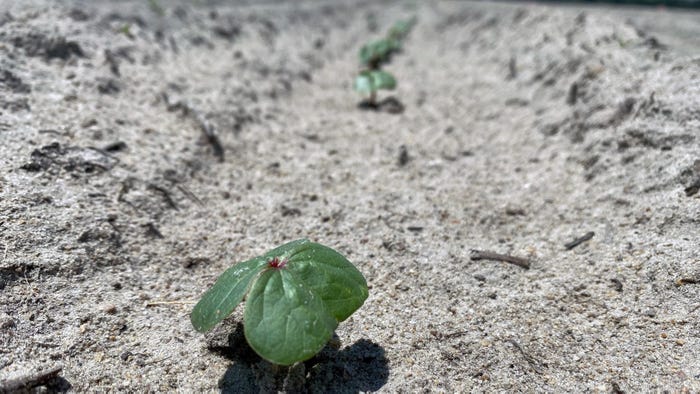
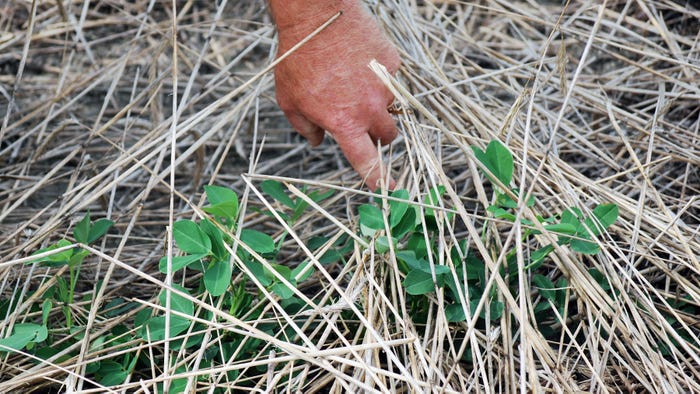
Though the Wiregrass area is a major agriculture center for the state, soybeans has not been a major crop there since the 1980s. Primary crops are peanuts and cotton, which can provide a natural barrier to the spread of soybean rust.

The site in Georgia is located in Miller County, in the city of Colquitt. Kudzu was found growing on the walls of an abandoned house in the southwest Georgia city. Miller County is on a north-south line roughly parallel to Henry and Houston counties in Alabama.

Like the Alabama counties, Miller County is primarily a peanut and cotton production area. Soybean production between these areas and more popular soybean production areas in Tennessee and the Carolinas is spotty at best.

Other than one find in a soybean test plot in South Texas, rust has been documented in numerous sites in northwest Florida, five counties in Alabama and two in Georgia in 2006.

e-mail: rroberson@prismb2b.com

Get Copyright ClearanceWant to use this article? Click here for options!
© 2009 Penton Media, Inc.


Latest Jobs

resources

events icon events

product info icon tradeshows

tradeshow icon digests

research icon photos

Continuing Education

Accredited in Florida, Georgia, New Mexico, Oklahoma, Texas, South Carolina and Tennessee:


(New Course)
Weed Resistance Management in Cotton

This course covers a wide range of options to effectively control weeds in cotton and reduce the risk of weed resistance management. It is accredited for hours/units for licensed/accredited applicators in 7 U.S. Cotton Belt states (Florida, Georgia, New Mexico, Oklahoma, Texas, South Carolina an d Tennessee. CCA credit is pending).

(New Course)
New Mode of Action Chemistry for Vegetable Production

Integration of a new mode of action compound like Coragen into IPM and IRM programs to control Lepidoptera in leafy greens, fruiting vegetables, peppers and brassica or cole crops is always welcome. This online CE accredited course details how best to use this new mode of action insecticide in intensive vegetable production. It is accredited by the Certified Crop Adviser (CCA) program and by state agencies for licensed applicators in Texas, Georgia, Florida, New Jersey and Pennsylvania.

(New Course)
Utilizing Calcium as Nutrient That Protects Against Disease Organisms

This online accredited course focuses on Calcium, an important plant nutrient in fertilizer management for maximum, healthy plant development as well as disease and pest prevention. It is accredited by the Certified Crop Adviser (CCA) program and for licensed applicators in licensed Georgia, Florida, Pennsylvania and New Jersey. Credit applications are pending in South Carolina, Tennessee, Virginia, West Virginia and Washington.

This course is accredited in Texas, Oklahoma, New Mexico, Virginia, West Virginia and Wyoming as well as for CCA credits:

(New Course)
Spray Drift Management

Keeping crop protection chemicals on the crop for which they are intended has been a cornerstone of farming not only to protect neighboring crops, but to not waste money allowing products to drift off the intended target. This accredited online continuing education course covers the critical elements of spray drift management.

Back to Top

Browse Print Issues

Additional Resources

subscribe to Farm Press Daily Delta Farm Press Southwest Farm Press Western Farm Press