Corn cobs on deck for cellulosic feedstock

• ARS scientists have determined that removing corn cobs from a field after harvest has no detrimental impact on sediment runoff or soil quality.

More About:

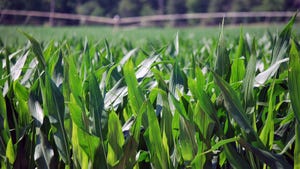
When energy officials proposed using crop residues to produce cellulosic ethanol, concerned soil scientists took to the fields to learn more about how these residues protect soil from erosion and enhance soil quality. Agricultural Research Service soil scientist Brian Wienhold focused on a single component of residue — the corn cob.

“We didn’t have data on how post-harvest cob residues might protect soil quality,” says Wienhold, who works in the ARS Agroecosystem Management Research Unit in Lincoln, Neb. “But corn cobs make up 20 percent of residue by weight, which means that the average U.S. production of corn could provide 40 to 50 million tons of cobs for feedstock every year.”

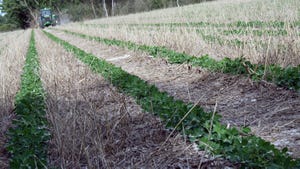
Wienhold led colleagues in studies that compared runoff from no-till corn fields where post-harvest crop residues were either removed or retained.

The scientists also removed the cobs from half of the test plots that were protected by the residues.

Then they generated two simulated rainfall events; the first occurred when the fields were dry, and the next occurred 24 hours later when the soils were almost completely saturated.

During the first event, on plots where residue was removed, runoff began around 200 seconds after the “rain” began, whereas runoff in the residue-protected plots didn’t start until around 240 seconds after it started to “rain.”

Runoff from the residue-free plots contained 30 percent more sediment than runoff from all the residue-protected plots. The presence or absence of cobs on the residue-protected plots did not affect sediment loss rates.

Wienhold’s team concluded that even though cob residues did slightly delay the start of runoff, they did not affect rates of sediment loss.

The results showed that the cobs could be removed from other residue and used for feedstock without significantly interfering with the role of crop residues in protecting soils.

In related studies, Wienhold examined how the removal of cob residues affected soil nutrient levels. He placed litter bags containing cob pieces on the surface of no-till fields or buried them 0 to 4 inches deep in the soil. Every 2 months, he tested cob samples from the bags for levels of carbon, nitrogen, phosphorus, potassium, sulfur, calcium, manganese, iron, magnesium, copper, and zinc.

Over the course of a year, his sampling indicated that cobs were a source of soil potassium, but they weren’t a significant source of any other plant nutrients.

Wienhold believes these findings demonstrate that harvesting cobs for biofuel production would not result in any notable loss of soil quality. This means that Nebraska’s York County — where average corn production results in around 0.2 million tons of cobs — could potentially provide enough cob feedstock every year to keep two 10.5-million-gallon ethanol plants in business.

Results from this work have been published in Agronomy Journal.


Discuss this Article 1

Anonymous (not verified)
on Feb 5, 2013

totally agree!
.. in addition, you can go one step further: Producing furfural is the best pre-treatment for a corncob based feedstock for cellulosic ethanol .. turning a cellulosic ethanol plant into a corncob bio-refinery (using lignin-residues as its fuel).
There is some great technology available to harvest corncobs on the go. Developed by Ag. engineers and farmers for farmers. I take the liberty to add this short-cut to one of our websites that asked the following question "Does the co-harvesting of maize and cobs make business sense?" http://goo.gl/Zyaoe.

Post new comment
Sign In or register to use your Southeast Farm Press ID
(optional)

Continuing Education Courses
New Course
The 2,000-member Weed Science Society of America’s (WSSA) Herbicide Resistance Action...
New Course
The course details six of the primary diseases affecting citrus: Huanglongbing (Citrus...
Potassium nitrate has a positive effect in controlling plant pests and diseases when applied...

Newsletter Sign Up