Tennessee switchgrass contracts awarded

Jun 18, 2009 12:57 PM, By Ann Ryan
University of Tennessee

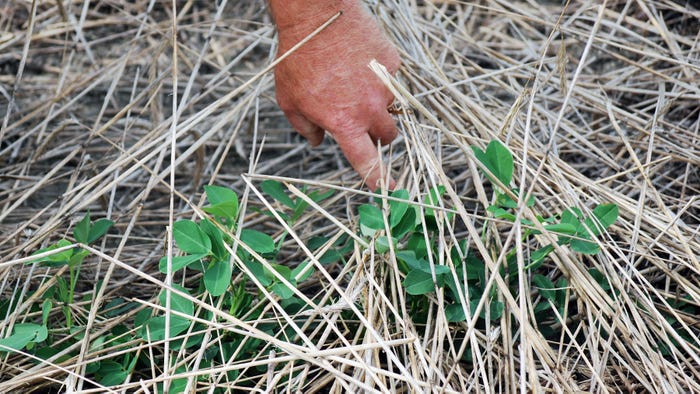
Switchgrass, along with corn cobs, will be used as feedstock in the state's first demonstration-scale cellulosic ethanol biorefinery.

Thirty-eight area farmers have received acceptance letters into the University of Tennessee’s second season of a switchgrass farmer incentive program.

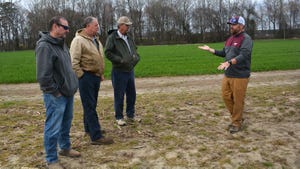
DAVE "Buck" and Paula Phillips, left, are just two of the many farmers growing switchgrass as part of a UT program. The Phillips, who planted 25 acres of switchgrass on their Friendsville, Tenn., farm this season, are joined by UT Extension's Ken Goddard, center, Jon Walton, second from right, and Andrew Griffith, right. (Photo by Ann Ryan)

The farmers will be growing switchgrass for conversion to cellulosic ethanol. A total of 1,901 acres located in nine East Tennessee counties were enrolled in the 2009 program.

The total acreage enrolled over the last two years is more than 2,600 acres. Twelve farmers of the chosen 38 are returning farmers who were involved in the program in 2008 and have added additional acreage for the 2009 season. The UT program is unique in that it is the only program partnering with actual producers to plant switchgrass on such a large scale as a dedicated energy crop.

Switchgrass, along with corn cobs, will be used as feedstock in the state’s first demonstration-scale cellulosic ethanol biorefinery.

Biorefinery construction is well under way in Vonore, Tenn. UT and its partner, DuPont-Danisco Cellulosic Ethanol, LLC, expects the pilot plant to be operational in late 2009.

UT officials, including Kelly Tiller, are excited about the second year of the program. Tiller is co-director of the UT Office of Bioenergy Programs in the UT Institute of Agriculture. “With the establishment of a large acreage of switchgrass in Tennessee, not only is there the ability to produce sustainable biofuels for the state and nation, but also great opportunities to conduct groundbreaking research on biomass production,” she said.

Joseph DiPietro, UT vice-president for agriculture, echoed Tiller’s enthusiasm. “We are very pleased with the success of the program’s first year and look forward to continuing success. The interest and eagerness shown by the Tennessee farmers has been outstanding. We are especially pleased to work with returning farmers from the 2008 program which substantiates continued interest and success of the program,” said DiPietro.

According to Ken Goddard, UT Extension biofuels specialist, “As of May 1, 2009, we have planted over 1,100 acres of seed on 19 of the 38 farms we have contracted with for the 2009 program. Our partnering farmers have worked hard to ready their fields for planting, while adequate soil moisture is available for good seed germination. An approximate planting goal of mid-May was the date we estimated for dry soil conditions in this area for the past two years. Producers with planted acreages will now have to monitor weed control problems as they occur and address weed competition either culturally or with approved herbicides,” said Goddard.

“This project is turning out to be one of the most rewarding things we have done,” said Paula Phillips, contracted farmer for the 2009 program.

Paula and David Phillips have 25 acres in Friendsville, Tenn., where they are growing switchgrass for the first time. “It is a great thing when one can learn about a perennial grass and the potential it has, then be used to actually bring that end result about,” she said. “We have yet to see what that end result will be, but we surely want to be involved in any process that helps this nation become more fossil fuel independent. Words cannot express our appreciation to the UT Extension office for the help they have given us. One thing is for certain, we couldn’t be more excited about watching the grass grow — and that for any farmer is an exciting change!”

In addition to the approximate 2,600 acres of switchgrass that is enrolled in the program, UT expects to enroll more acreage into the farmer incentive program for planting in spring 2010. Up to an additional 3,000 acres may be added to the program.

For more information about the Tennessee Biofuels Initiative, visit the UT Office of Bioenergy Programs Web site at http://www.UTbioenergy.org.

Get Copyright ClearanceWant to use this article? Click here for options!
© 2009 Penton Media, Inc.


Latest Jobs

resources

events icon events

product info icon tradeshows

tradeshow icon digests

research icon photos

Continuing Education

Accredited in Florida, Georgia, New Mexico, Oklahoma, Texas, South Carolina and Tennessee:


(New Course)
Weed Resistance Management in Cotton

This course covers a wide range of options to effectively control weeds in cotton and reduce the risk of weed resistance management. It is accredited for hours/units for licensed/accredited applicators in 7 U.S. Cotton Belt states (Florida, Georgia, New Mexico, Oklahoma, Texas, South Carolina an d Tennessee. CCA credit is pending).

(New Course)
New Mode of Action Chemistry for Vegetable Production

Integration of a new mode of action compound like Coragen into IPM and IRM programs to control Lepidoptera in leafy greens, fruiting vegetables, peppers and brassica or cole crops is always welcome. This online CE accredited course details how best to use this new mode of action insecticide in intensive vegetable production. It is accredited by the Certified Crop Adviser (CCA) program and by state agencies for licensed applicators in Texas, Georgia, Florida, New Jersey and Pennsylvania.

(New Course)
Utilizing Calcium as Nutrient That Protects Against Disease Organisms

This online accredited course focuses on Calcium, an important plant nutrient in fertilizer management for maximum, healthy plant development as well as disease and pest prevention. It is accredited by the Certified Crop Adviser (CCA) program and for licensed applicators in licensed Georgia, Florida, Pennsylvania and New Jersey. Credit applications are pending in South Carolina, Tennessee, Virginia, West Virginia and Washington.

This course is accredited in Texas, Oklahoma, New Mexico, Virginia, West Virginia and Wyoming as well as for CCA credits:

(New Course)
Spray Drift Management

Keeping crop protection chemicals on the crop for which they are intended has been a cornerstone of farming not only to protect neighboring crops, but to not waste money allowing products to drift off the intended target. This accredited online continuing education course covers the critical elements of spray drift management.

Back to Top

Browse Print Issues

Additional Resources

subscribe to Farm Press Daily Delta Farm Press Southwest Farm Press Western Farm Press