NCSU degree program feeds the 'bio' industries

Apr 17, 2007 10:24 AM, By Suzanne Stanard
North Carolina State University

Bioindustries are booming in North Carolina, and along with that explosive growth comes a need for skilled workers. Enter the new Bachelor of Science degree in Bioprocessing Science at North Carolina State University.

The degree program, offered by the Department of Food Science in the North Carolina State College of Agriculture and Life Sciences, prepares students for careers in bio-industries through formal training in the fundamental sciences as well as hands-on lab experience. The first class of students enrolled this spring.

“It was one of those ‘aha’ moments,” says Donn Ward, head of the Department of Food Science. “There’s a huge biomanufacturing industry in North Carolina and a growing demand for trained workers. We want to help meet that need.”

Chris Daubert, North Carolina State associate professor of food science who led the effort to establish the new degree program, agrees. “The potential is definitely there for North Carolina and the Triangle to attract new biotechnology companies, and we’re uniquely positioned to help deliver a highly skilled workforce to the industry,” he says.

The statistics add up: There are 20,000 North Carolinians working as biotechnologists in the pharmaceutical and biopharmaceutical industries, and more than 2,500 new employees may be required annually, according to the North Carolina Biotechnology Center.

The U.S. Department of Commerce says that North Carolina was the No. 1 state for creating new biotechnology companies from 1997 to 2001. And, according to Ernst & Young, the state has the third largest biotechnology industry in the U.S.

The new degree program will produce graduates trained in basic sciences such as chemistry, engineering, microbiology and biotechnology, Daubert says. They’ll also learn good manufacturing practices and standard operating procedures. And, their lab experience will be like none other.

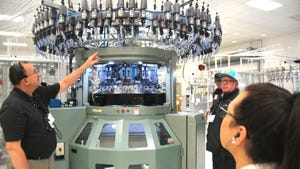
The North Carolina Biomanufacturing Training and Education Center (BTEC) on N.C. State’s Centennial Campus is a state-of-the-art facility designed to prepare students for the biomanufacturing workforce. The BTEC labs simulate those in biomanufacturing companies, giving students real-world work experiences.

Students will even “gown up” for their lab work, Daubert says.

BTEC has been a tremendous partner in the effort to establish the new degree, Daubert says. In addition to providing its facility for use by bioprocessing science students, BTEC funded one full-time faculty position in the Department of Food Science — an engineer who will be one of the primary professors in the new degree program.

The North Carolina Biotechnology Center also has been supportive of the new degree program, Ward adds, developing a series of job classifications and categories that helped shape the curriculum.

Ward sees the new degree program as a natural evolution for the department, a complement to its nationally recognized undergraduate and graduate programs in food science.

“As far as I know, we are the only bioprocessing science curriculum in the country,” he says. “Our department has demonstrated success in training scientists for the food industry, and now we’re adapting to a changing environment by training scientists for a new industry. We want to stay ahead of the curve.”

e-mail: suzanne_stanard@ncsu.edu

Get Copyright ClearanceWant to use this article? Click here for options!
© 2009 Penton Media, Inc.


Latest Jobs

resources

events icon events

product info icon tradeshows

tradeshow icon digests

research icon photos

Continuing Education

Accredited in Florida, Georgia, New Mexico, Oklahoma, Texas, South Carolina and Tennessee:


(New Course)
Weed Resistance Management in Cotton

This course covers a wide range of options to effectively control weeds in cotton and reduce the risk of weed resistance management. It is accredited for hours/units for licensed/accredited applicators in 7 U.S. Cotton Belt states (Florida, Georgia, New Mexico, Oklahoma, Texas, South Carolina an d Tennessee. CCA credit is pending).

For National Certified Crop Advisers

A free, accredited, self-study 1-CEU on spray drift management for all for all American Society of Agronomy Certified Crop Advisers in the U.S. and Canada.

Back to Top

Browse Print Issues

Additional Resources

subscribe to Farm Press Daily Delta Farm Press Southwest Farm Press Western Farm Press